edx-platform no longer directly imports or requires the enterprise module.
Enterprise behavior is provided entirely via well-defined plugin hooks.
Operators can install the official plugin, their own fork, or run non-enterprise LMS with zero enterprise code.
This would provide cleaner code boundaries, reduce coupling, and make enterprise functionality truly optional.
The goal of this post is to gather feedback on direction and identify potential collaborators before investing heavily in implementation.
Background: Current Pain Points
Today, edx-enterprise is tightly coupled with edx-platform through direct imports across core modules. The ENABLE_ENTERPRISE_INTEGRATION setting doesn’t fully disable enterprise code paths or imports.
For operators:
Customizing or forking edx-enterprise requires maintaining compatibility with upstream module names and function signatures indefinitely.
Enterprise code paths cannot be fully switched off, increasing error surface area even for non-enterprise deployments.
For developers:
Tight coupling obscures where enterprise code lives and creates risk of unintended side-effects when modifying either enterprise or platform logic.
Proposed Solution
We evaluated simpler alternatives (requirement swaps, patchsets) but found they created unsustainable maintenance burdens. Instead, we propose to convert edx-enterprise into a true plugin, which can be done incrementally in phases:
Define a clear “Enterprise plugin interface” in edx-platform using the existing plugin framework.
Please see the attached PDF for the full proposal details.
How to Get Involved
Please reply if you have an interest in collaborating, or also if you have any specific feedback/concerns. If there’s positive interest, I may move forward with an Open edX Enhancement Proposal (OEP) to facilitate collaboration. Looking forward to your feedback and seeing if this can become a shared community effort!
+1!. I have for years thought this is the right approach to edx-enterprise. It was one of the first use cases we tried to understand when initially developing the hooks framework. As a maintainer of the events and filters libraries, I’d be happy to help move things along.
If you see that there are things that are required for this migrations that the libraries don’t yet support, I’ll also be happy to remove those blockers.
I think this makes a ton of sense, and it will be good to get the interface points needed to make this work moved to openedx-events and openedx-filters.
FYI, my team got the green light to start work on this. This also coincided with gaining claude-code access, so I spent almost a week doing a claude deep-dive and generated about 80% of the overall work as draft PRs. These are designed to be mergeable and deployable incrementally, so no need to do a big bang release.
Some of them are good to go, but most need additional work. While the CI are failing, checks do pass locally where my virtualenvs are wired correctly to install as editable (pip install -e) the libs they depend on. There are other issues, e.g.:
Sometimes claude decided to run isort against files which should have been excluded from isort,
pluggable_overrides were never actually wired up in plugin_settings,
libraries all still need version bumps,
etc.
Feel free to take a look and put in some reviews! In the meantime, we’ll spend the next ~month chipping away at all the tickets to carry these over the line.
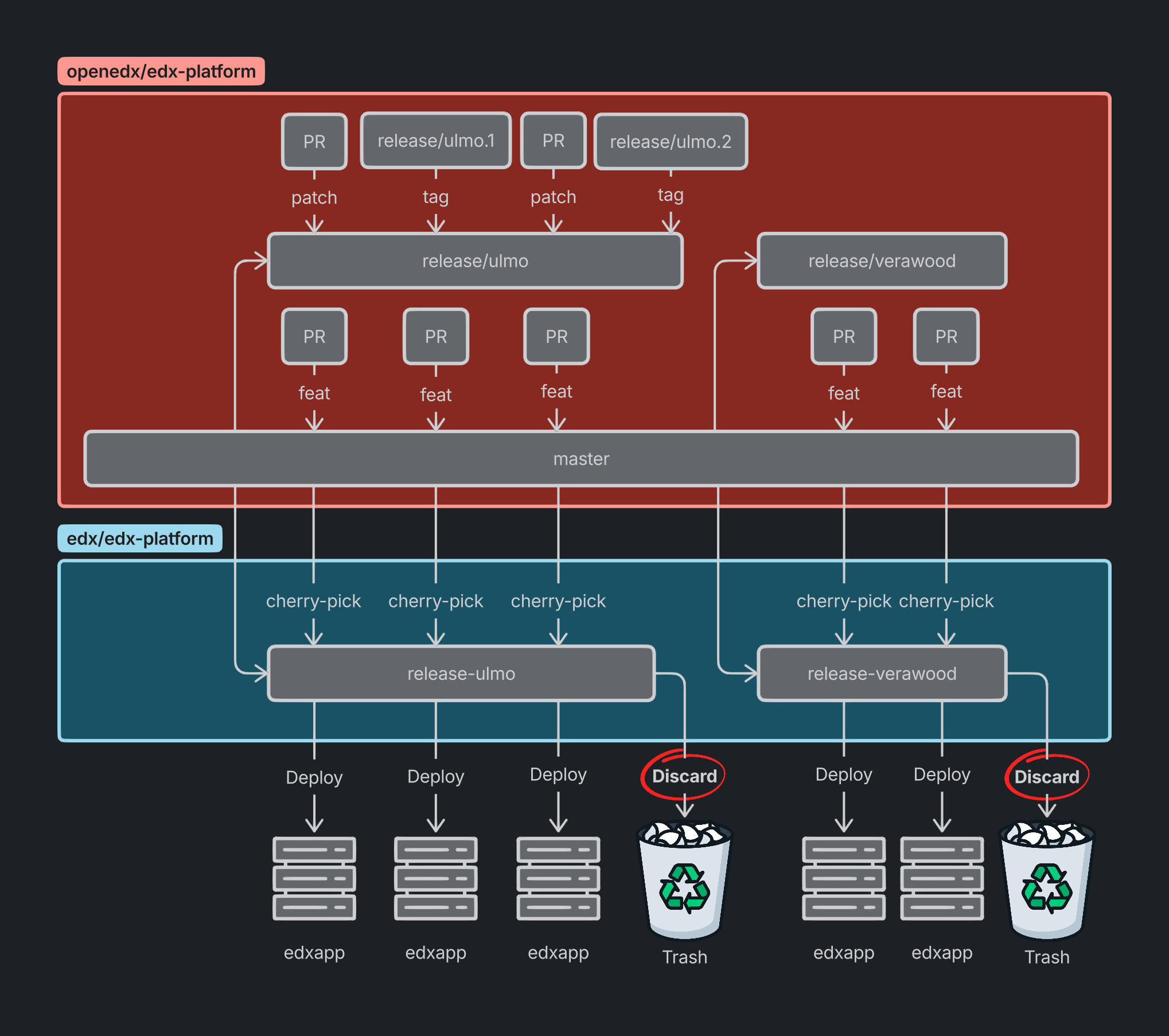
The goal is to leverage the specific 1-month approval for capacity to get as much in as possible, starting last week. Each grouping of PRs are designed to be mergeable and deployable in isolation. It’s inevitable that we cut a release with half of these merged in.
If that’s not okay, then I guess we could just merge to our local edx/edx-platform fork, then do a big bang backport upstream before we trash our release-ulmo branch, but it starts to get confusing.
Here’s what I mean by “trashing” our release-ulmo branch:
I just wanted to give a status update on this project as light is appearing at the end of the tunnel.
73 of 83 total estimated PRs merged, or 88% complete by this metric.
JIRA
Description
PRs Merged
State
ENT-11563
Grades Analytics Event Enrichment
4/4
Done
ENT-11510
User Account Readonly Fields
4/4
Done
ENT-11564
Discount Enterprise Learner Exclusion
4/4
Done
ENT-11473
User Retirement Enterprise Cleanup
4/4
Done
ENT-11565
Ent Username Change Command
2/2
Done
ENT-11544
DSC Courseware View Redirects
8/8
Done
ENT-11566
Third Party Auth Enterprise Pipeline
5/5
Done
ENT-11567
SAML Admin Enterprise Views
4/4
Done
ENT-11568
Logistration Enterprise Context
5/5
Done
ENT-11569
Student Dashboard Enterprise Context
5/5
Done
ENT-11570
Enrollment API Enterprise Support
4/4
Done
ENT-11571
Learner Home Enterprise Dashboard
3/3
Done
ENT-11572
Course Home Progress Ent Name
3/3
Done
ENT-11573
Course Modes Enterprise Customer
4/4
Done
ENT-11575
Programs API Enterprise Enrollments
3/3
Done
ENT-11663
Plugin Registration Prep
7/7
Done
ENT-11830
Migrate Filter Injection
4/4
Done
ENT-11574
Support Views Enterprise Context
0/4
TODO
ENT-11576
Enterprise Support To Edx Enterprise
0/3
TODO
ENT-11577
Migrate Enterprise Settings
0/3
TODO
I’m approved (for now) to take this over the line despite losing all my dedicated engineers, so this last stretch might be a long tail.
Of course, the end goal is to remove edx-enterprise from the list of dependencies in openedx-platform, but that cannot happen until the very last PR is merged.
 Done
Done TODO
TODO