Hi @digitalchild - unfortunately, I’m not sure if that’s possible in the current way grading is set up. A few people who I would tag (@dave , @kmccormick ) are currently away, but maybe @braden knows?
@sarina is right that you can’t require a minimum of 70% in each Type. If you have four equally weighted Types and a 70% passing minimum, someone could get 100%, 100%, 100%, and 0% and still pass.
(I took a course in college like this; the professor encouraged anyone on pass/fail to just skip the final if they had enough points to pass. In fact, most of my courses were like that, but I didn’t take them pass/fail, so it was worth showing up for the final.)
Further detail for those who are interested: I had to make a diagram to understand the edX grading scheme back when I was first working on it, so now you get to benefit from that! Description of the diagram to follow.
I’m going to provide a little extra explanation here so that people who find this later can understand, and also because writing alt text for a beast like that is impossible.
The total grade is 100%.
You assign that percentage to Types. In the diagram, there’s a Homework type worth 40%, a Quizzes type worth 60%, and a Practice type worth 0%.
Types can be weighted anywhere from 0% to 100% (if you just want one category and not separate homework / quiz / final / whatever).
You cannot drop Types.
Learners still get marked right/wrong on 0% Types, it just doesn’t impact their grade.
Types are made up of Subsections. These are the the mid-level folders that contain pages.
You cannot weight subsections. They all count for the same.
You can drop subsections. Whichever one the learner gets the least points in is removed from the average.
The Quizzes type in this diagram has four individual quizzes, one of which is being dropped because the learner didn’t do well on it.
Subsections contain Problems.
Problems can be assigned weights (point values), so different problems in the same subsection can be worth different amounts.
Problems cannot be dropped.
Because subsections all count for the same within a Type, lopsided courses can end up with some real weird results. See Quiz 3 on my diagram, where a single 1-point question is 20% of your overall grade.
There’s no “minimum across all types” option, just averaging, dropping (subsections), and weighting (not subsections).
Now, you could use prerequisite subsections to gate the later quizzes behind getting a 70% or better on the earlier quizzes. However, learners cannot retake quizzes - they get additional attempts on individual problems instead - so this is mostly just a way to force people out of a class. Cannot recommend.
Firstly, thanks for the detailed explanation. It would be good if that diagram was in the documentation. Would it be possible to create a custom grading plugin that would set minimum pass rates per assignment type?
I think Im going to need a final exam assignment type that does a full knowledge assessment for all course content. As my current design allows a learner to completely skip being tested on some of their knowledge.
I don’t know of any easy extension point for a plugin to set minimum pass rates for an assignment type. In theory, we could have a filter that allows plugin code to override grade pass/fail logic at the point that our system receives the event signal for a score change, but we’d also need effective ways to message this to both authors (Studio Grading Policy page), and students.
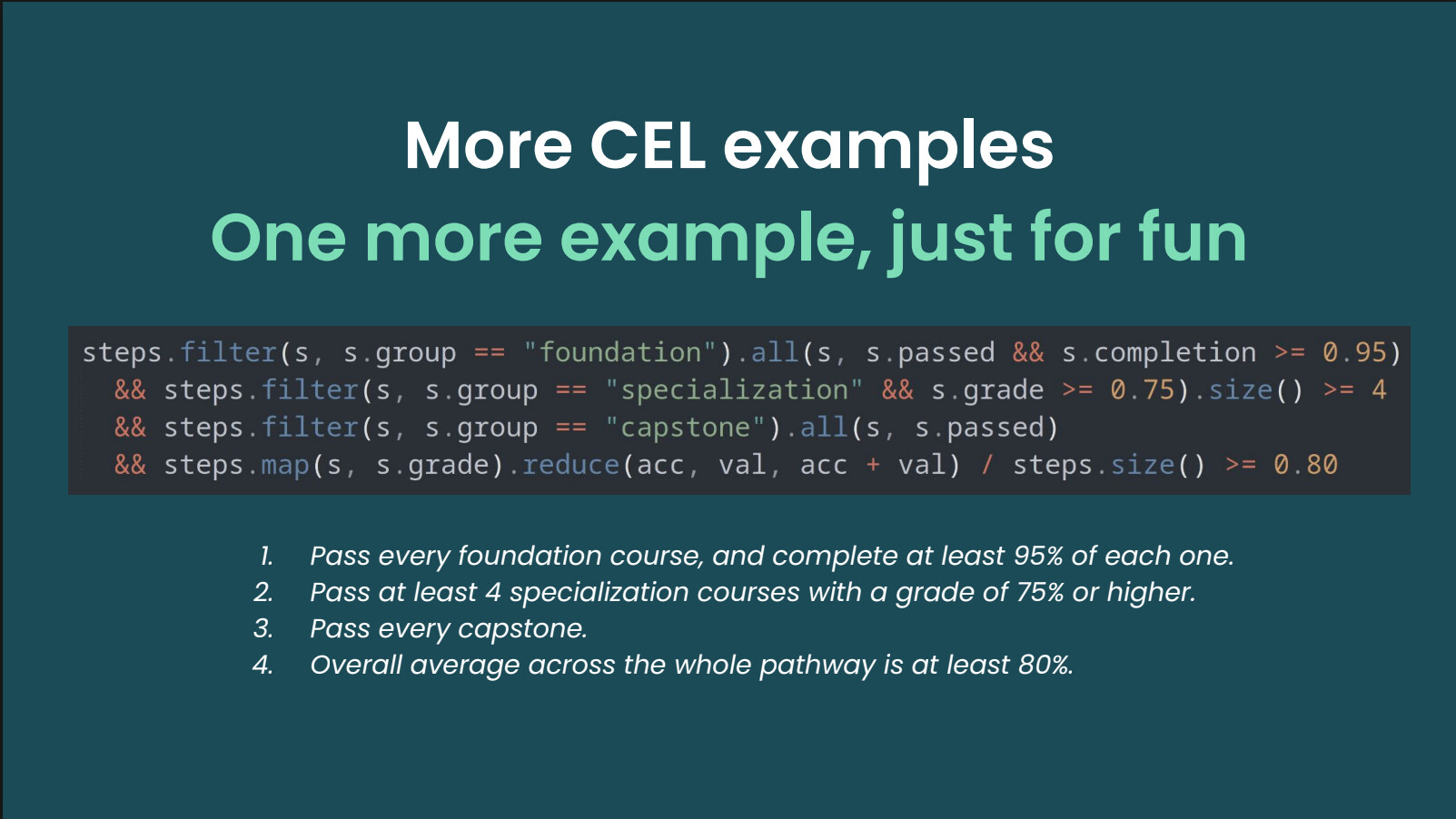
The plan is for Learning Pathways to allow for a lot more flexibility. @Agrendalath recently gave a talk on this, and slides 15-20 from his deck demonstrate some of the things we’re looking to do, like this:
But development work on this is just starting, and it’ll probably be a year before we have this properly released in platform. Even at that point, the first things to go in Pathways will be entire courses, and building a pathway out of more granular pieces might be further away.
Thanks @dave for the extra information and the link to the slides. What is the current status of learning pathways? Is there a ticket/branch I can follow? We have just implemented Programs which I know have been deprecated because I didn’t know there were learning pathways.
The next round of work will be kicking off soon, at which point there will be a project board that you can follow for up-to-the-minute details. There’s also a wiki page for it:
That top-level page is empty, but if you go to “Watch Settings” and select “Watch child items”, you should get updates on any new product or technical documents being worked on. There is also a #modular-content-deliverychannel in Slack, which sometimes has Pathways discussion, but also has things like competency based education discussions, and some in-the-weeds technical discussions as well (since they are being implemented with overlapping core platform capabilities).